
Five Singles in Under Two Years: A Short Guide to X-Ray Spex and the Designs That Carry Them

In 1976, a young Londoner called Marianne Elliott-Said went to see the Sex Pistols play in Hastings. She came home and started a band. Within a year she was Poly Styrene, the band was X-Ray Spex, and their first single opened with a line that still stops a room: "Oh bondage, up yours!"
What followed was one of the busiest short runs in British punk. Five singles and an album landed between September 1977 and April 1979. If you have only heard the first one, this guide walks through the rest, and points to the X-Ray Spex pieces that suit each chapter, from kids' tees to fleece hoodies.
How did X-Ray Spex come together?
Poly Styrene found her bandmates through an ad in Melody Maker asking for "young punx who want to stick it together". The original lineup was Poly on vocals, Jak Airport on guitar, Paul Dean on bass, B.P. Hurding on drums and Lora Logic on saxophone.
That saxophone is the thing most people remember first. Punk bands of the time rarely had one, and Lora Logic was a teenager when she played it: she left in 1977, aged 16, to form Essential Logic. Rudi Thompson took over the sax from 1977 to 1979. Put a loud, young, female-led front line together with a honking horn and you get a sound that is hard to mistake for anyone else.
If you want the longer version of that story, the band's own page on who X-Ray Spex are goes through the lineup and the years in more detail.
What are the five singles, in order?
Here is the run, as released:
- "Oh Bondage Up Yours!" (September 1977). The debut. Poly described it as an anti-consumerist jingle, and it is often seen as a forerunner of riot grrrl.
- "The Day the World Turned Day-Glo" (March 1978). The song that gave the band its loudest colour: day-glo yellow, red and pink on stark black and white.
- "Identity" (July 1978). The third single in under a year, and a nod to the theme of identity that runs all through the band's look.
- "Germfree Adolescence" (October 1978). Released a month before the album it named.
- "Highly Inflammable" (April 1979). The last single before Poly Styrene left that year for her solo album, Translucence.
The album Germfree Adolescents arrived in November 1978. A second, Conscious Consumer, followed much later, in October 1995.
Which designs go with the early, day-glo singles?
The first year of X-Ray Spex is all attitude and colour, and the designs that suit it are the loud ones.
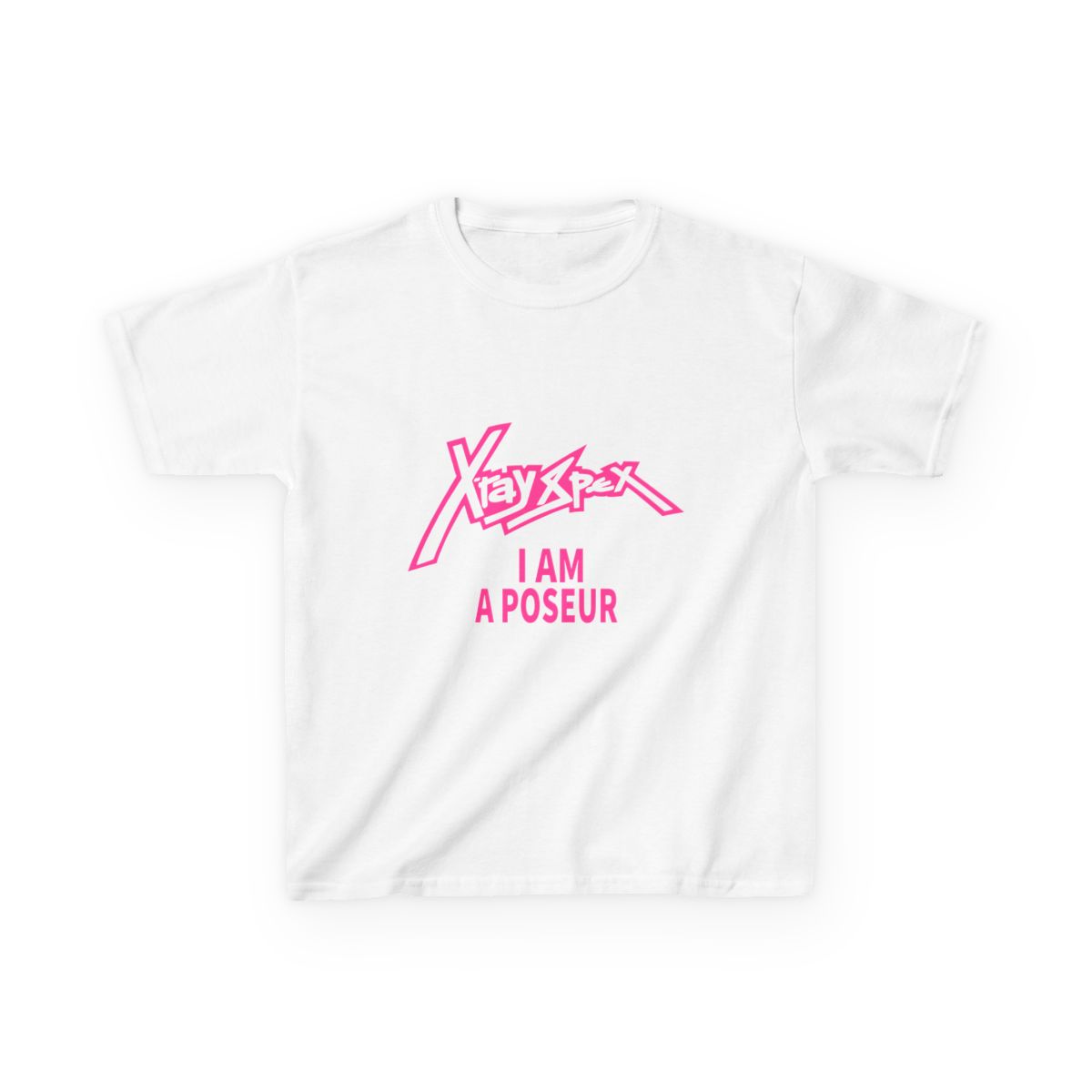
The I Am a Poseur kids' tee puts the band's scrawled name in outlined hot pink above a bold two-line I AM A POSEUR slogan. It has the same tongue-out spirit as the early records, and on a small person it is very funny.
The red, orange-red and pale grey scrawl logos are the simplest way in: just the name, drawn by hand, with a tall first X and a long stretched final one. Red on black and white is the band's own colour story, so the red version is the classic pick; the pale grey is the quieter one.
For something with a figure in it, the Pink Triangle Singer design shows someone in a helmet and goggles with a raised fist on a magenta triangle. It comes on a kids' tee, and there is also a Pink Triangle Singer crewneck sweatshirt for grown-ups who want that day-glo pink on a heavier layer this winter.
What about the Germfree Adolescents era?
By late 1978 the band had an album out, and its look is the test tube. Two designs come straight from it.
The Germfree Adolescents Test Tubes design lines up five test tubes, each holding the same figure in a different coat colour, with the band's name and the album title around them. It reads like a row of specimens, which is exactly the point of a record about growing up clean, packaged and labelled.
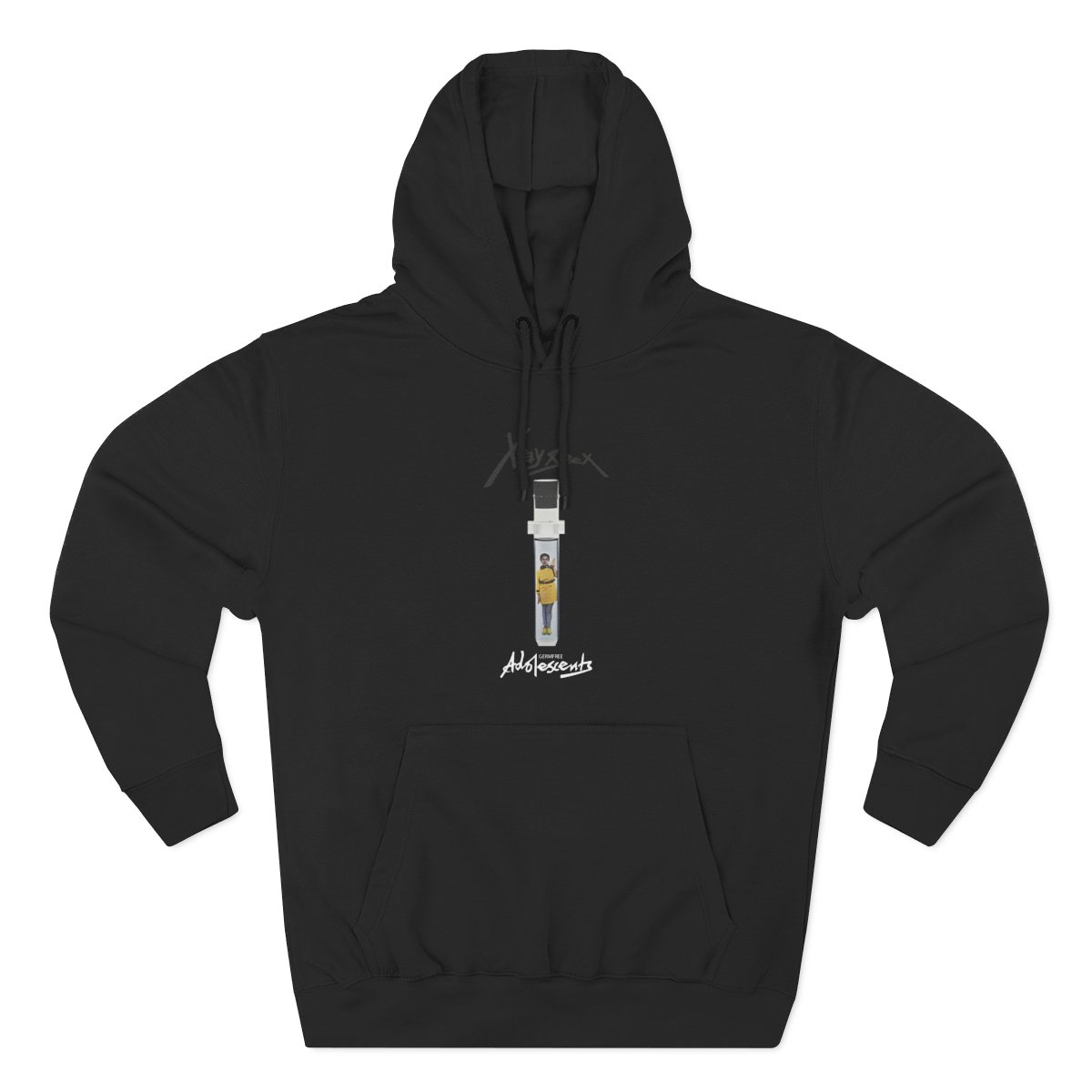
The single Yellow Test Tube design pulls one of those figures out on its own, in a yellow coat under the black X-Ray Spex scrawl. It is the more graphic of the two, and the yellow is the day-glo shade that runs through the band's imagery. You can get it as a kids' tee or as the Yellow Test Tube fleece hoodie, which is the one to reach for on a cold walk to a gig.
There is also the Globe Lama Poseur design: the green scrawl across a black globe on a stand, with a script line on the base. It is one of the more detailed pieces in the range and a nice choice if the plain logos feel too simple.
Did the story end in 1979?
No, and this is the part people often miss. After Poly Styrene left, the band came back several times: in 1988, in 1991 with a gig at Brixton Academy, in 1995 and 1996 around Conscious Consumer, and in 2008 at the Roundhouse in London on 6 September, where they played Germfree Adolescents almost in full.
Jak Airport died in 2004, and Poly Styrene died on 25 April 2011, aged 53. The songs have outlived both of them, and so has the anti-consumerist streak that ran through Poly's lyrics.
Which piece should you pick?
A quick way to choose:
- For a first X-Ray Spex piece: the red scrawl logo. It is the band at a glance.
- For a child who likes to make a statement: the I Am a Poseur tee.
- For the album: the Germfree Adolescents test tubes, or the yellow test tube on its own.
- For colder months: the Yellow Test Tube hoodie or the Pink Triangle Singer crewneck. There is a Christmas knit-pattern hoodie with the name in red capitals among trees and zigzags, too.
Start with whichever single you play the most, and wear the design that goes with it.